
Situational Analysis.
Customer Segmentation.
For Balenciaga to recover, conducting an analysis on their customer provides insight into their preferences, giving a sound foundation to find opportunities to embrace. Customer segmentation is the first step to situational analysis defined by demographic, psychographic, geographical, and behavioural, and can be visualised in the customer profile in the appendix.
The Balenciaga consumer is between the 18–34-year-old demographic, known as Generation Z and Millennials, and conveniently for Balenciaga an audience that will makeup 70% of the luxury market by 2025 (WARC, 2022). To help gain a clearer picture of opportunities for Balenciaga, the current gender split is 52.85% men (SimilarWeb, 2023), but changes sporadically, meaning any recommendation must cater for both genders. The market of Balenciaga is high-end, which their target consumer reflects, describes as ‘HENRY’S’, high earners not rich yet (Radonic, 2022).
Moving onto psychographic, this analyses the personality, values, and beliefs of Balenciaga's consumer. Label conscious, fashion-forward and unique (Deloitte, 2017) are just a few traits, showing that Balenciaga’s original consumer wants branded recognisable clothes. The consumers personality tends to fall in line and match the brand they are buying from and who they aspire to be or relate to (Deloitte, 2017), 83% favour brands that align themselves with their own values (Retail Touchpoints, 2022). Balenciaga should consider this as a recommendation after regaining consumer trust, to prove their morals have realigned. Secondly, they value experiences, a trend which has become increasingly popular (VERB, 2023), explaining why they shop at Balenciaga, creating relationships through sales associates, after-sales care and strong brand identity, solidifying their love for labels (Dalziel, 2020). Other values include becoming a more informed consumer (Bain, 2022), having a two-way communication strategy to build loyalty (BOF, 2022) and valuing brand authenticity (Pastore, 2022).
Geographic features are important when recommending a consumer-focused campaign. The US, Korea and the UK are the biggest consumers (SimilarWeb, 2023), found most predominantly in urban areas, leading to popularity in streetwear and comfortable relaxed workwear (WGSN, 2023), something Balenciaga excel in.
A final factor to note is the behaviour found in their spending habits. An average spends of $2500 on luxury purchases (Merks-Benjaminsen, 2013) falls in line with Balenciaga’s price point, explaining their rapid growth; making these purchases emotional, well thought out and saved for due to the young nature of the target market (Moran, 2021).

Fear of God (2015)
The second analysis is external, looking at competitors, featured in the appendix, Table 1 displays direct, indirect and replacement competitors, analysing their strengths, weaknesses, opportunities, and threats, as well as the 4 P’s (McCarthy, 1960). Also featured is the perceptual map. Here highlights key points featured in the Table 1, starting with Gucci, a direct competitor. Strengths include internationally recognisable branding similar to Balenciaga but only 40% of their lines considered trendy (Roberta, 2021),weakening their portfolio. The opportunities, threats and 4 p’s can be found in Table 1. As for indirect competitors, Dior similarly to Balenciaga have a strong heritage and high margins with accessories and apparel having large mark-up’s, raising profits (Farra, 2020). Tommy Hilfiger (indirect) , strengths involve consistency with communication, a friendly personality and tapping into the everyman and caregiver archetype (Thehartford.com, 2019), something Balenciaga needs to incorporate to reposition.

Yet Hilfiger has little expansion into technological advancements, despite consumers now preferring e-commerce (Deloitte, 2022), they haven’t explored features like AI, something Balenciaga are already thriving in. Vetements, is directly a competitor, being fashion-forward, setting the trends rather than following, allowing great expansion despite being a young brand (Highsnobiety, 2023). A key weakness is their advertising, rarely using traditional advertising like Out-of-home, rather putting more effort into social media marketing which limits off audiences that don't rely solely online for fashion inspiration or shopping (Pocketstop, 2019). Finally, EGO, the replacement competitor, this provides the look for less, making it highly accessible to a range of audiences due to low price points, (Assoune, 2020). Yet there are major ethical concerns and wastage into the environment (Eller, 2021).
Since assessing the situation around Balenciaga next is conducting a SWOT analysis. Analysing their strengths help find areas to build on, opportunities to embrace and threats to prepare for. Further explained in Table 2, the strengths, Balenciaga provide trend setting, practical everyday wear (Givhan, 2019), a factor to further develop and build on consumer style preference, creating strong brand awareness. As well as making progressive steps into rental and reselling (Balenciaga, 2023), to keep in touch with the target customers value for sustainability (Petro, 2021).
Perceptual Map
Balenciaga SWOT.
Competitor Analysis

However, there are weaknesses causing the reposition, the controversial brand nature and carelessness in marketing promotions (BOF, 2023), the distant and lack of emotive language causes a barrier between customer and brand stopping any potential relationship. After looking at weaknesses, this provides opportunities. Starting with as mentioned, creating relationships through consistent emotive marketing, focusing on communication strategy; an opportunity to create a two-way humanised conversation and link this new friendly tone to the type of imagery Balenciaga put forward to remain consistent across all touch points. Looking more at an opportunity based off consumer profiling research, the lack of consumer disposable income means Balenciaga can explore into an essentials range which would reach wider audiences at a slightly lower price point. Finally threats, their designs are too daring which can limit their audience and with a high price point they could easily fail.

Fear of God (2022)
Fear of God (2022)
STEEPLED
Now to look at the market trends, categorised into STEEPLED. Here mentions the key factors impacting the industry but also ones relevant to repositioning Balenciaga, the full analysis can be found in Table 3. Beginning with Socio-Cultural, consumers desire to feel valued by brands, businesses can learn to understand their consumer to communicate better, aligning their values, something 84% of Gen Z and Millennials now look for to stay loyal to a brand, the main target audience of luxury fashion (Polkes, 2020). Secondly consistently tailoring content to consumers; the relevance to Balenciaga is once again understanding the customer, previously Balenciaga has offended an entire market with tasteless imagery based off a Chinese holiday (Marketing-interactive, 2020), suggesting a rethink into this factor. Technological involves, reinforcing the B2C conversation, seamless omnichannel links from adapting accessible e-commerce (Berg, 2022).
Combining Ecological and Environment, alongside the demand for sustainable clothing, consumers are now prioritising purchasing essential items and staples to consume less, with the aim to create a timeless wardrobe, Harper’s Bazaar indicates trends are no longer in, meaning consumers are looking for clothing that doesn’t age, for Balenciaga this could mean moving away from fashion-forward to suit consumer behaviour shifts so they don’t lose their appeal as no desire for past art direction (Klerk, 2021), this works in favour with the suggested reposition recommendation.
Balenciaga Website 2022
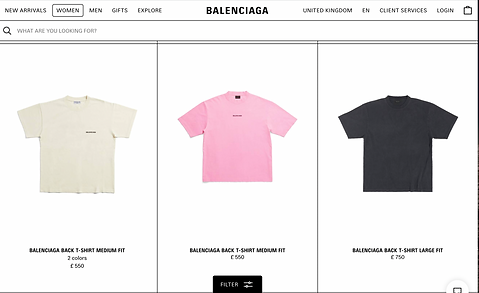
Moving onto Economic, consumers face a decrease in disposable income, as mentioned, this affects consumers purchasing entry level goods; this could potentially impact Balenciaga as small leather goods are the most popular product, yet the high earners of the target market are less likely to be impacted. Finally demographic, 18-34-year-olds are ‘strivers’, a group heavily influenced by digital media who believe luxury sets them apart (Carufel, 2018).